RTP and House Edge Explained: How Casino Games Pay Out
When people play Royal X Casino games, two terms can help them understand how casino mathematics works: RTP and house edge.
These figures do not tell you whether your next spin, hand, or roulette bet will win. Instead, they describe the mathematical design of a game over a very large number of rounds.
Understanding the difference can also prevent a common mistake: assuming that a game with a 96% RTP will return Rs.96 every time you wager Rs.100. That is not how RTP works.
What Does RTP Mean in Casino Games?
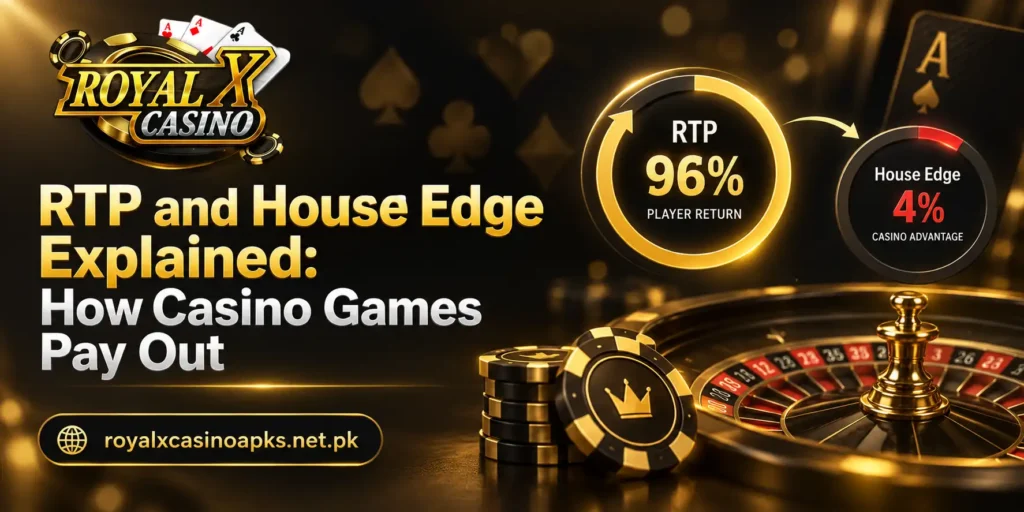
RTP stands for Return to Player.
It is usually shown as a percentage and represents the theoretical portion of wagers that a game is designed to return to players over a large amount of gameplay.
For example, imagine a slot has a theoretical RTP of 96%.
That does not mean:
- every Rs.100 bet returns Rs.96;
- every player will recover 96% of their money;
- a short session will finish close to 96%;
- the remaining 4% is removed from every individual bet.
The UK Gambling Commission explains that RTP is an average achieved across a significant number of game plays rather than something guaranteed during an individual playing session.
Simple RTP Example
Suppose a hypothetical casino game has an RTP of 95%.
Over an extremely large amount of qualifying play, its mathematical design aims to return approximately 95% of the total amount wagered.
The remaining percentage represents the mathematical advantage built into the game.
But one player could lose several bets in a row, while another could win early.
Neither short session tells you whether the published theoretical RTP is accurate.
What Is House Edge?
The house edge represents the mathematical advantage that the casino has in a particular game.
The UK Gambling Commission describes house edge as a measure of the percentage a casino would expect to keep on average from casino games such as roulette and blackjack under normal patterns of play.
A simple way to understand the relationship is:
Theoretical RTP + House Edge = approximately 100%
For example:
If RTP = 96%
Then the theoretical house edge = 4%
If RTP = 97.5%
Then the theoretical house edge = 2.5%
This calculation is useful for simple fixed-return examples, although some casino games have more complicated rules and different bets can carry different mathematical margins.
RTP vs House Edge: What Is the Difference?
RTP and house edge look at the same basic casino mathematics from opposite directions.
RTP Looks at the Player Side
Return to Player describes the theoretical percentage returned through prizes over long-term gameplay.
A higher theoretical RTP generally means a smaller built-in mathematical margin, assuming you are comparing games on the same basis.
House Edge Looks at the Casino Side
House edge describes the mathematical advantage retained by the game over the long run.
A lower house edge usually means that less of the total amount wagered is theoretically retained by the house over a sufficiently large sample.
Neither number predicts what will happen during your next session.
Does 96% RTP Mean You Will Get Rs.96 Back From Rs.100?
No.
This is probably the most important point to understand about casino RTP.
Suppose you deposit Rs.100 and use the full amount on a slot advertised with a theoretical RTP of 96%.
You could finish with:
- Rs.0;
- Rs.40;
- Rs.100;
- Rs.300;
- or another result entirely.
A 96% RTP is not a personal refund rate.
It is a theoretical long-term figure.
The Gambling Commission specifically notes that someone might play many spins without winning while another person could win repeatedly over a small number of spins. RTP cannot be accurately judged from one person’s short playing history.
Why Short-Term Results Can Look Completely Different
Casino games contain variance, often discussed as volatility.
Random results can move far above or below the theoretical average during a short session.
Imagine flipping a fair coin ten times.
You would expect roughly five heads and five tails over time, but one set of ten flips could easily produce seven heads and three tails.
The same general statistical idea explains why short casino sessions can look very different from theoretical RTP.
As the amount of gameplay grows, actual results are expected to move closer to the game’s mathematical model, although individual players can still experience very different outcomes.
The Gambling Commission notes that the tolerance around theoretical RTP becomes narrower as the volume of play increases.
What Is Game Volatility?
Volatility, sometimes called variance, describes how results may be distributed.
It is different from RTP.
Two Royal X Casino slot games could theoretically display the same RTP while providing very different playing experiences.
Low-Volatility Games
A lower-volatility game may tend to produce smaller winning results more frequently.
That does not mean you cannot lose money.
It simply describes the pattern in which outcomes may be distributed.
High-Volatility Games
A high-volatility slot may produce fewer successful combinations but occasionally offer larger potential payouts.
This can result in longer losing stretches.
A high advertised maximum win should therefore never be confused with a high chance of actually receiving it.
RTP and Slots on Royal X Casino
If you play Royal X Casino slots, look for an information icon, help menu, paytable, game rules, or RTP section.
Where an RTP figure is provided, read it directly from the current game information.
Do not assume every slot has a 96% RTP simply because another game does.
Different slot titles can have different mathematical models.
Some games can even be offered in more than one RTP configuration, depending on the game provider and platform setup.
For that reason, this article does not assign an unverified RTP percentage to individual Royal X Casino games.
How House Edge Works in Roulette
Roulette is a useful example because its mathematical advantage is easier to see.
A roulette wheel contains numbered pockets, including one or more zero pockets depending on the version.
The payout for common bets does not fully compensate for the presence of the zero.
That difference creates the roulette house edge.
European vs American Roulette
European roulette normally contains a single zero.
American roulette traditionally includes both a single zero and double zero.
Because the American version contains an additional house number, its standard bets generally carry a larger house advantage than comparable European roulette bets.
So before playing a roulette game, check which wheel variation is being used.
What About Teen Patti?
Teen Patti works differently from a slot machine.
There can be several Teen Patti formats, betting options, side bets, and table rules.
The mathematical advantage may therefore depend on the particular version being played.
Do not take a house-edge figure from one Teen Patti variant and assume it applies to every Royal X Casino Teen Patti table.
Open the table rules and understand how hands, bets, and payouts work first.
Does Previous Game History Affect the Next Result?
For independent random games, previous outcomes normally do not tell you what the next random outcome will be.
Seeing five losing spins does not mean the sixth spin is “due” to win.
Likewise, seeing red appear repeatedly in roulette does not prove black must appear next.
The Gambling Commission notes that for random machines, the odds of winning the current game remain constant and are not changed simply because previous games won or lost.
This mistaken belief is commonly known as the gambler’s fallacy.
Can RTP Help You Choose a Casino Game?
RTP can be one useful piece of information when comparing games, but it should not be considered a winning strategy.
For example, if two similar games clearly disclose different theoretical RTP figures, you may prefer to understand why they differ.
But RTP does not tell you:
- when a game will pay;
- which spin will win;
- how much you personally will lose;
- whether a bonus round is about to start;
- which number will appear in roulette.
It describes long-term game mathematics, not future results.
Can You Beat the House Edge?
There is no betting system that can reliably remove the built-in mathematical advantage from ordinary chance-based casino games.
Changing your bet after a loss does not change the underlying probability of an independent random outcome.
Strategies such as doubling a bet after every loss can actually create another problem: the amount being risked grows quickly.
A short winning sequence may happen, but it does not prove the mathematical edge has disappeared.
How to Check RTP Before Playing
Before using a Royal X Casino game online, open its information section.
Look for details such as:
Game Rules
Understand what creates a winning result and how bets are settled.
Paytable
For slots, the paytable normally explains symbol values, paylines or ways to win, wild symbols, scatter symbols, and bonus features.
RTP Information
If an RTP percentage is disclosed, check the figure shown for that specific game rather than relying on a percentage from an unrelated website.
Volatility
Some games identify themselves as low, medium, or high volatility.
This can help you understand how uneven the game’s results may be.
Maximum Bet
Check the available betting range before starting. Increasing the stake does not improve the underlying probability simply because more money is being risked.
RTP Does Not Make Gambling an Investment
A high RTP percentage can sound attractive because numbers such as 96% or 97% appear close to 100%.
But anything below 100% still represents a negative mathematical expectation under the stated conditions over time.
That is one reason casino games should be treated as entertainment rather than a reliable method of making money.
Winning sessions can happen.
So can losing sessions.
Neither changes the underlying mathematics of the game.
Responsible Play Matters More Than RTP
Understanding RTP and house edge can help you make more informed decisions, but responsible limits matter more.
Before playing:
- decide how much you can afford to lose;
- do not use money needed for bills or essentials;
- avoid chasing previous losses;
- do not borrow money to continue playing;
- stop when your preset limit is reached.
A high-RTP game can still result in the loss of your entire session budget.
FAQs About RTP and House Edge
Conclusion
Understanding RTP and house edge makes casino game mathematics much easier to interpret.
RTP describes a theoretical long-term return across a large amount of gameplay, while house edge describes the mathematical advantage built into a casino game. Neither percentage can predict your next result or guarantee how much money you will receive back during a session.
When playing Royal X Casino games, check the rules, paytable, RTP information, volatility, and betting limits for the specific title you choose.
Most importantly, never mistake a high RTP percentage for guaranteed profit. Casino results remain uncertain, so use a fixed entertainment budget and never risk money you cannot afford to lose.